




Notes on Ellijay Carpentar Bee Treatment
This handout is to explain better in writing what is involved with the East Ellijay Carpenter Bee Treatment, as well as what to expect over the next several days and weeks.
First, lets talk about how carpenter bees life cycle works in the Ellijay area, and then you will understand better why we treat the way we do. We use the abbreviation “CB” for carpenter bees throughout this article. Here is the "expected" life cycle from start to finish.
Eggs are laid late spring to early summer in nests drilled out in dead wood. Nests may contain several eggs. Soon after being laid they'll hatch and feed on pollen for a month or two before pupating to adults.
In late summer they'll emerge as adults and spend the remainder of the year hunting for pollen. As fall turns to winter both males and females will hibernate till the following spring. They will use pre existing nests to hibernate and these nests will many times house several bees. Once it's warm enough the following spring, they'll emerge from their nests seeking fresh pollen and a mate. Soon after mating males will begin to die and females will both fill pre existing nests with new eggs as well as drill out new nests following their instinctive behavior to expand the local population. Females will live long enough to lay her eggs and maybe even most of the summer but usually not two winters.
As many log home owners have found out, they will often use the same nest over and over which is why nests on structures need to be dusted thoroughly with a long lasting treatment dust. Failure to fend them off when you first see activity will usually lead to more and more coming around.
CB are prevalent throughout the United States. Although there are different species, the most common is big and resembles a bumble bee. You may find it foraging around flowers, shrubs and under the eaves of buildings. This bee is unique from most because it will bore into wood to make its home. They are a nuisance and can cause damage to any wood on your property. They also bother homeowners by "attacking" them though they rarely sting. To keep your home free of CB, you must know their biology and habits.
CB bore holes into wood overhangs, fence posts, and trees. They will crawl between cracks of siding and roofing. When they bore in wood, the hole they drill is about the size of a dime. This hole will go straight an inch or two and then turn 90 degrees. Only the females drill holes in wood, since they are the ones that will be laying the eggs. Once the drilling has been completed, she will spend her days foraging for food. You may find her working Azaleas, Bradford Pears, Daffodils, Pansies and any plant which will provide pollen in early spring. Male bees will be hanging around these same plants hoping to find a receptive female who is still interested in finding a mate. The male bees are naturally curious and will buzz around anything moving including people, pets just about anything they see moving. The male stays outside and “guards” the hole, primarily by running off other males and females that might want to make use of the hole. This buzzing scares people into thinking they are being "attacked". In fact, the male bee does not have a stinger! He has a distinctive yellow face, which may be seen while he is in flight. Female bees have no interest other than collecting food. As stated above, they have a stinger but their face is black which is in contrast to the male bees. CB are commonly mistaken for bumble bees. There are two differences. 1) Carpenter bees are generally larger. 2) Carpenter bees have an abdomen which is shiny, metallic and black in color. Their abdomen has no body hair. Bumblebees have yellow and black body hair on all body parts.
In addition to "attacking" residents, CB are a problem because they tend to return to the same wood or location where they were born. Old nests are used year after year. If the original nest is occupied, other female bees will drill new nests. A single nest one year will become two or three the next. Problems rapidly escalate and soon you may have hundreds of holes. When you have numerous CB nests, you will have numerous larva. The larva of CB is large and noisy. They make enough noise to attract woodpeckers. Buildings which have woodpeckers damaging exposed wood probably has some type of larval activity which is attracting the birds. This insect is most likely carpenter bee larva.
Carpenter Bee Control:
To get rid of CB, you must think long term. The nuisance male bees are easy to kill with wasp spray or a badminton racket. Unfortunately, killing the male bee will do nothing to stop the cycle. You must treat the nest with some material which will last a long period of time so it will effectively stop the current active bees as well as the larva. If you spray liquid residuals in their hole, you may kill the female. The eggs are protected, however, and six to twelve months later the larva will emerge. Since liquids are absorbed by porous wood, the treatment will be gone when the larva finally hatches. This means the larva have a strong chance of survival. To insure complete control, we use a dust that has a desiccant (dehydrating) action and when the larva emerges, they will be killed quickly. We recommend that entry holes are treated with the dust and then left unsealed. When they do finally emerge (which will be either later this year or early next year), the bees will crawl over dust and die soon after leaving the nest, stopping the cycle.
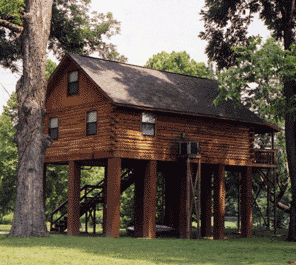
Of course, to get rid of carpenter bees that are foraging to start new nests, you must consider all exposed wood that meets the criteria for carpenter bee nest locations. Some people recommend painting wood to protect against C.B., but I have seen them drill right into freshly painted wood with repellant added. Also, if you own a log home, painting the exterior wood surface is NEVER recommended because of the likelihood of paint causing rot formation within the logs. Since cellulose is where they want to call home, wood used on any structure may become a target. If the structure is a log cabin or one with natural wood siding with
shakes that are exposed, expect to be attracting carpenter bees every season. All wood gives off a decay odor which attracts these bees and once the structure is found the bees will start their nest making. To stop them from boring new nests, we apply a contact insecticide that also repels the C.B. Our product is active against many pests such as wasps, spiders, ants and of course CB. Although rain and humidity will break down the chemical, it is active enough so that even trace amounts will chase these CB away and force them to find and build nests elsewhere.
You probably will continue to see some active bees in the area around your house for a few days after our treatment. Remember, the bees must land on the eaves and contact the insecticide for it to kill them. If they attempt to drill a new hole in a sprayed area, they WILL die! Our spray is very effective. However, it is also repellant, so usually you should expect them to show up, buzz around, and eventually leave. The CB that have nests already, will probably enter their nest anyway, even with the repellant spray. After all, this is their home! The dust in the holes will make short work of them, only taking a day or so for them to exit and die. Remember, as the repellant insecticide slowly wears off over the next 2-3 months, the dust in the holes will keep killing the CB that show up to take advantage of the free drilling already done for them!
If you can’t stand them around at all, your Ellijay carpenter bee treament company come out in three months and apply the spray again for a reduced price, and that should get you all the way into fall where the activity is dropping off anyways.
In short, expect to see a reduction in bees as we kill all the active ones in the holes, but you may still see several males and newcomers buzzing around, but they will not be drilling holes, and they cannot sting you, so just use them for tennis practice.